Growing Rosemary Indoors: The Tricky One
Rosemary is one of the harder herbs to keep inside. This honest guide explains the strong light, cool room, careful watering and airflow it needs, and why plants dry up or turn powdery.

If you have lost a rosemary plant indoors, you are in good company. It is a woody evergreen shrub that thrives outside in sun and moving air, and it is one of the harder herbs to keep in a house. Plants that looked perfect in autumn often turn brown and brittle by late winter, or pick up a pale powdery coating.
That does not mean growing rosemary indoors is a lost cause. It means the plant has narrow preferences, and the usual indoor spot, warm, dry, dim and still, misses nearly all of them. Knowing what it is asking for gives your next attempt a much better chance.
Why rosemary struggles inside
Rosemary comes from bright, breezy Mediterranean coasts. Its needle-like leaves and woody stems are built for strong sun, lean ground and fresh air. A typical living room offers the opposite on three counts:
- Light through a window is far weaker than outdoor sun, and winter makes it weaker still.
- Heat from central heating keeps the plant warm when short days are telling it to slow down.
- Air indoors is still, which lets dampness linger on crowded foliage.
None of these is fatal alone. Together, over a whole winter, they wear the plant down. The care below is about closing each gap as far as your home allows.
The strongest light you have
Put rosemary in the brightest window available, close to the glass. In the Northern Hemisphere that usually means an unshaded south- or southwest-facing window. Around six or more hours of direct sun is the commonly suggested rough guide for sun-loving herbs, and rosemary sits at the demanding end of that group.
In winter, even a good window may fall short. A lamp helps: positioned above the plant and run on a timer, it can make up for short, gray days. The guide to grow lights for herbs explains how close to set one and how long to leave it on.
Cool and bright, not hot and dry
Rosemary prefers a cool, bright room over a hot one. An unheated sunroom, a bright enclosed porch that stays above freezing or a cool bedroom window often suits it better than a spot near a radiator or heat vent. Warmth combined with low light tends to produce weak, pale growth.
Keep the foliage from touching freezing glass, and keep the pot out of the blast of hot air from a vent, which dries the needles and the mix quickly.
Watering: the hardest part
Watering rosemary is a balance between two risks, and both are real.
On one side, the roots rot in soggy mix. Use a free-draining potting mix, opened up with perlite or coarse sand, in a pot with a drainage hole, and never leave water standing in the saucer or cachepot.
On the other side, a pot left bone dry can kill the plant, and rosemary gives little warning. Its stiff needles do not droop the way basil leaves do, so the plant can look unchanged until the tips turn brown and brittle, by which time the damage is done.
The answer is to check the mix often instead of waiting for the plant to tell you. Push a finger about an inch (2.5 cm) into the pot, or lift it to feel its weight. When the top has dried, water thoroughly and let it drain. The full method is in the guide to watering indoor herbs.
Good to know
Brown, dry needle tips have several possible causes: a pot that dried out completely, roots damaged by wet mix, or hot dry air from a vent. Feel the mix and look at the drainage before deciding which one you are dealing with.

Space and moving air
A white or gray powdery film on the needles is commonly powdery mildew, a fungal problem that stagnant air encourages. Rosemary kept indoors in still, crowded conditions is prone to it.
Prevention is mostly physical:
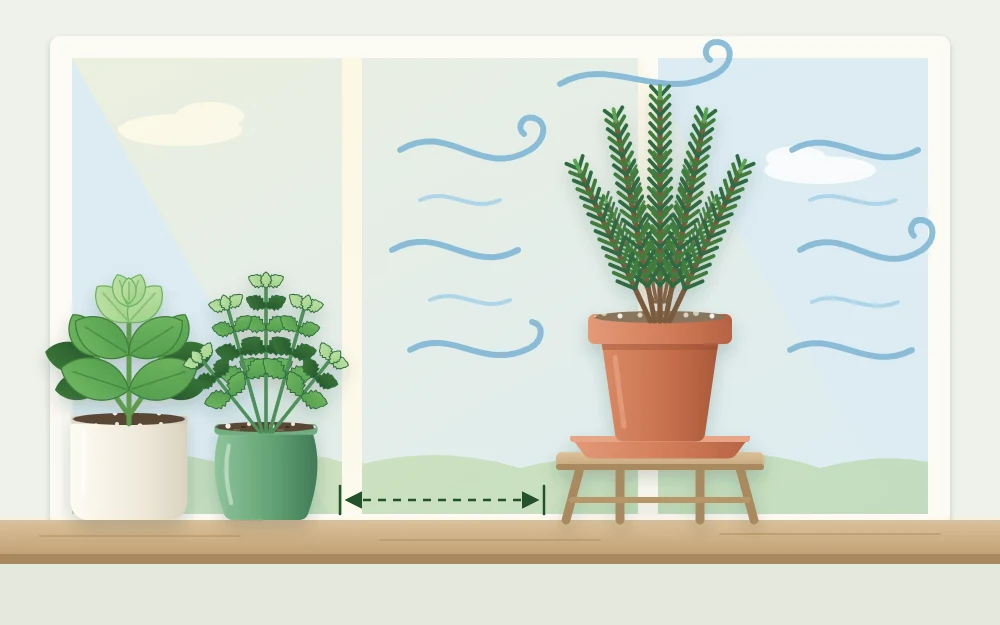
- Give the pot room, so its branches do not press against other plants, curtains or the wall.
- Choose a spot where air moves gently, away from closed-in corners.
- Water the mix, not the foliage.
- Snip out badly affected tips and thin congested growth so air can pass through the plant.
For more detail, see University of Maryland Extension’s page on powdery mildew on indoor plants. If you ever consider a product, use only one whose label lists edible herbs and indoor use, and follow the label exactly, including any waiting time before harvest.
Start with a plant or a cutting
Begin with a healthy nursery plant, or root a cutting taken from a soft green shoot tip. Seed is not the practical route: it is slow, often taking several weeks, and it germinates poorly, so many seeds never come up at all.
Many indoor rosemary plants begin as outdoor pots carried in before frost. That move is a shock in itself, because the light drops sharply overnight. Doing it gradually, and checking the plant for pests first, makes a real difference; the steps are in the guide to bringing outdoor herbs indoors.
Harvesting and shaping
Snip the soft tips, cutting just above a set of leaves on green growth. This gives you the most tender sprigs and encourages the stem to branch. Avoid cutting into bare old wood, because leafless brown stems often do not sprout again.
Harvest lightly in winter, when the plant is barely growing and cannot replace what you take. Save heavier trimming for spring and summer.
Rosemary and pets
The ASPCA lists rosemary as non-toxic to dogs, cats and horses, as you can see in the ASPCA entry for rosemary. Keep the pot out of reach all the same, and contact a veterinarian if a pet eats a plant and seems unwell.
Fair expectations
Even with good care, some rosemary plants do not make it through a winter indoors. Treat a plant that survives until spring as a success, and move it back outside for the warm months if you can, hardening it off gradually. If one fails, look back at light, temperature, watering and airflow, change the weakest of the four and try again with a fresh young plant.
Frequently asked questions
Why did my rosemary dry up indoors?
Several things can cause it. A pot that dried out completely is common, because rosemary does not wilt as a warning. Roots damaged by soggy mix, hot air from a vent and weak winter light can produce similar browning. Check the mix, the drainage and the plant's position before deciding what went wrong.
What is the white powder on my rosemary?
A pale powdery film on the needles is commonly powdery mildew, which stagnant air encourages. Give the pot more space, move it somewhere with gentle air movement, water the mix instead of the foliage and snip out the worst tips. If you use a product, choose one labeled for edible herbs indoors and follow the label.
Can I grow rosemary from seed indoors?
You can try, but it is not the practical route. Rosemary seed is slow, often taking several weeks, and germinates poorly, so many seeds never appear. A healthy nursery plant or a cutting rooted from a soft green shoot tip gives you a usable plant much sooner and with far less disappointment.