Potting Soil for Indoor Herbs: What to Look for in a Mix
Why garden soil fails in containers, what the ingredients in a bagged potting mix do, and how to adjust a mix for dry-loving herbs such as thyme and rosemary.

It seems logical that soil from the yard would be fine for a pot. Plants grow in it outdoors, after all. In a container, though, it behaves very differently, and it is one of the more common reasons a first pot of herbs struggles.
Choosing potting soil for indoor herbs is not complicated once you know what a mix has to do. This guide explains why bagged potting mix works, what the ingredients on the bag are for, and how to adjust a mix for herbs that like it drier.
Why garden soil fails in pots
In the ground, soil is part of a deep, connected system. Water drains down and away, and worms and roots keep channels open. A pot has none of that.
- It compacts. With repeated watering, garden soil in a container settles into a dense block that roots find hard to push through.
- It drains poorly. The fine particles hold water tightly, so the pot stays wet at the bottom and little air reaches the roots.
- It may carry pests and weed seeds. Soil from outdoors can bring insects, their eggs and seeds of unwanted plants into your kitchen.

What a good potting mix does
Most bagged potting mixes contain no actual soil, which is why they are often called soilless mixes. They are blends of light, coarse materials chosen to do one job that sounds contradictory: hold water and air at the same time.
After you water, the particles keep a film of moisture that roots can draw on, while the gaps between them drain and refill with air. Roots need both. A mix that manages this stays springy in the hand, wets evenly and lets extra water run out of the drainage hole within moments.
For more background on container mixes, see the NC State Extension Gardener Handbook chapter on plants grown in containers.
What the ingredients on the bag do
Ingredient lists vary, but most mixes are built from a few kinds of material.
- Peat or coir makes up the bulk of many mixes. Both are fibrous materials that hold water.
- Perlite is the white, lightweight grit you see in most mixes. It keeps the blend open so air can get in and water can drain.
- Vermiculite is a soft, flaky mineral that also opens up a mix, and it holds more water than perlite does.
- Compost or bark adds structure and coarser pieces. Compost also contributes some nutrients, and bark helps keep a mix from packing down.
A general-purpose indoor or container mix with a blend like this is a sound starting point for herbs. Avoid bags described as garden soil or topsoil, which are meant for beds outdoors and are too heavy for pots.
Matching the mix to the herb
Herbs do not all want the same moisture, and you can nudge a standard mix to suit each group.
Standard mix for the leafy herbs
Basil, parsley, mint and chives like potting mix that stays evenly moist without turning soggy. A standard potting mix, straight from the bag, does this well and needs no changes.
A grittier blend for Mediterranean herbs
Thyme, oregano, rosemary and sage come from dry, stony places and want a free-draining mix that dries faster. Blend extra perlite or coarse sand into standard potting mix for them. The blend should feel noticeably looser and grittier than the mix alone.
Use coarse sand and not fine sand. Fine sand fills the air gaps in a mix instead of opening them, which makes drainage worse.
Tip
The pot adds to the effect of the mix. A gritty blend in unglazed terracotta dries fastest, and a standard mix in plastic stays moist longest. The guide to choosing pots for indoor herbs covers that side of the pairing.
Seed-starting mix is for sowing
Seed-starting mix is finer and lighter than regular potting mix. The small, even particles sit close around tiny seeds and let delicate seedlings push through without obstacles. That is useful for small seed such as thyme and oregano, which is sown on the surface.
It is made for sowing and the first weeks of growth, and it usually holds little in the way of nutrients. Once seedlings have true leaves and are ready for their own pots, move them into regular potting mix.
Pre-moisten dry mix before potting
Potting mix straight from the bag is often dry, and dry peat in particular sheds water at first. If you pot a herb into it and then water, the water can run down the sides and out while the center stays dry.
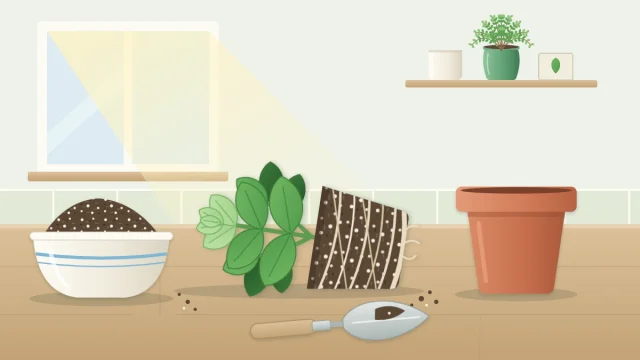
- Tip the amount you need into a bucket or bowl.
- Add a little water and stir it through with your hands.
- Keep adding and mixing until the mix feels evenly damp, like a wrung-out sponge. A squeezed handful should hold together loosely without dripping.
- Fill your pots, firming the mix gently and leaving a little space below the rim for watering.
For the full potting process, see the guide on how to repot herbs.
Potting mix and feeding
Potting mix is not a long-term food supply. Whatever nutrients it starts with are used by the plant and washed through with watering, so the mix runs low over time. That is why potted herbs are usually given some fertilizer, where garden herbs often get by without it.
The general approach is simple:
- Feed lightly during the months when the plant is actively growing.
- Feed less, or pause, in winter when growth slows.
- Follow the product label for how much to use and how often, and check that the product is intended for edible plants.
More is not better. Heavy feeding tends to give soft, lush growth that is weaker and often less flavorful, and the Mediterranean herbs in particular do well on little.
Good to know
Potting mix does not last forever. Over a year or two it breaks down, settles and holds more water than it did when fresh. If a pot that used to drain quickly now stays wet, tired mix is one possibility, and repotting into fresh mix often helps.
How the mix changes your watering
The mix you choose decides how often a pot needs checking. A grittier blend dries sooner, and a moisture-holding mix stays wet longer, so check each pot individually instead of watering them all together. The guide on how to water indoor herbs explains the finger test and the rest of the method.
Frequently asked questions
Can I use garden soil for indoor herbs?
It is not a good choice for pots. Garden soil tends to compact in a container, drain poorly and leave roots short of air, and it may bring insects or weed seeds indoors. A bagged potting mix is made to stay loose in a pot and is the more dependable option for herbs.
Do herbs need a special potting mix?
Not usually. A general-purpose potting mix suits basil, parsley, mint and chives as it comes. For thyme, oregano, rosemary and sage, blending in extra perlite or coarse sand gives the faster drainage they prefer. Seed-starting mix is only needed for sowing, not for growing herbs on.
How often should potting mix be replaced?
There is no fixed interval. Potting mix gradually breaks down and settles, often over a year or two, and starts to stay wetter and drain more slowly. When that happens, or when a herb has become root-bound, repotting into fresh mix gives the roots air and room again.