Growing Herbs Indoors in Winter: Light, Water and Windows
Why windowsill herbs slow down in winter and how to adjust light, watering, position, harvesting and feeding to keep them healthy until spring.

The basil that filled out all summer has stopped making new leaves. The parsley sits unchanged from one week to the next. Nothing is necessarily wrong. Growing herbs indoors in winter means working with far less daylight than the plants had a few months ago, and they respond by slowing down or pausing.
The aim for the cold months is modest: keep plants healthy until the light returns, and take a small harvest along the way. That mostly means adjusting four things, which are light, water, position and your own expectations.
What changes in winter
Short days and weak, low-angled sun are the main limit. Even a window that gave strong direct sun in July delivers much less in December, for fewer hours. With less light a plant makes less growth, uses less water and needs less feeding.
The indoor climate shifts too. Heating dries the air, windows stay shut so air moves less, and the space right beside the glass can be far colder at night than the rest of the room. Most winter trouble with herbs traces back to one of these.
Make the most of the light you have
- Move pots to the brightest window. In the Northern Hemisphere that is usually one facing south, then west or east.
- Clean the glass inside and out. Dust and grime cut the light more than you might expect.
- Clear the sill. Pull back curtains fully during the day and move anything that shades the pots.
- Turn pots a quarter turn now and then so the plants do not lean hard to one side.
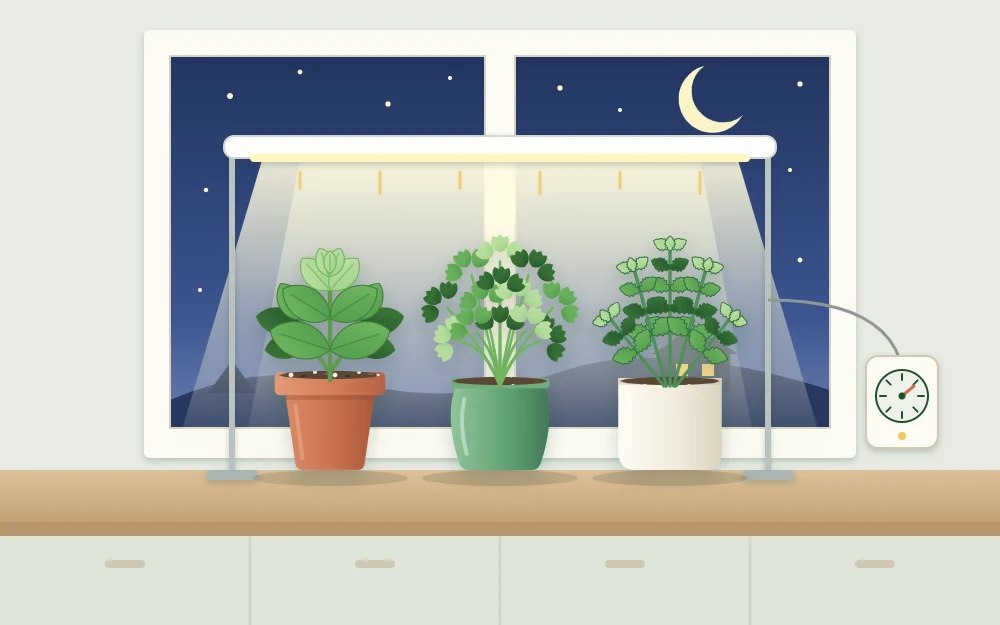
If your herbs still stretch and grow leggy, the window is not supplying enough, and a lamp is the practical answer. As a rough guide, roughly 12 to 16 hours under a lamp is commonly suggested for herbs, used alongside whatever daylight they get. The guide to grow lights for herbs explains how to set one up.
Water less often, but keep checking
In low light and cooler conditions, potting mix dries more slowly. A pot that needed water often in summer may stay moist for a good deal longer now, and watering out of habit is how roots end up sitting in wet mix.
Heated rooms can do the opposite. A small pot near a warm vent may dry out quickly even in midwinter. So there is no winter rule to follow, only the usual check: feel the mix about an inch (2.5 cm) down and lift the pot to judge its weight before you water. See the guide on how to water indoor herbs for the full method.
Tip
Use water at room temperature in winter. Water straight from a very cold tap chills the root ball of a plant that is already growing slowly.
Keep pots away from cold glass and hot air
A windowsill in winter has two hazards close together. The glass can be freezing at night, and many sills sit directly above a radiator or heat vent.
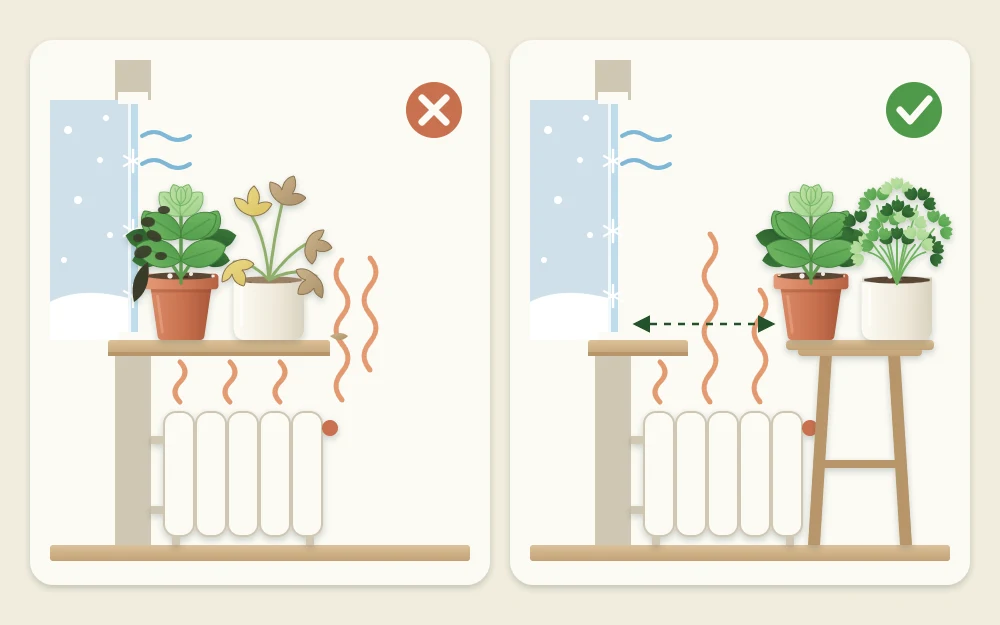
- Make sure no leaves touch the pane. Move pots back a few inches, or onto a small stand or table just inside the window.
- On very cold nights, shift tender herbs away from the window, and never leave them shut between a closed curtain and the glass.
- Keep pots out of the stream of hot air from radiators and vents, which dries leaves and mix quickly.
- Avoid spots beside doors that open to the outside, where plants catch cold drafts.
Good to know
Basil is the first to suffer from cold. As a rough guide, it tends to be unhappy below about 50°F (10°C), and leaves that touch cold glass can darken and collapse after a single night. Give it your warmest bright spot.
Harvest lightly and hold back on feeding
A plant that is barely growing cannot replace what you cut. Take a few sprigs or leaves at a time, leave plenty of foliage on the plant, and wait for visible new growth before you pick again.
Feeding should also ease off. Fertilizer cannot make up for missing light, and a resting plant does not use it. Many growers stop feeding in the darkest months, or feed very lightly, following the product label, if a plant is actively growing under a lamp.
Dry air and still air
Heated air is dry, and closed windows mean little air movement. Spider mites tend to do well in warm, dry conditions, and crowded plants in still air are more prone to mildew. Space pots so their leaves do not overlap, remove dead foliage, and let some air circulate around them. Rosemary is particularly sensitive to the combination of low light, still air and wet roots; the guide to growing rosemary indoors covers its winter care.
How different herbs behave
Not every herb responds to winter in the same way.
- Chives and mint may die back or rest for a while. This is normal for these perennials. Keep the mix barely moist and they commonly return when the days lengthen.
- Parsley likes cooler conditions and often keeps going slowly at a bright window.
- Thyme, oregano, rosemary and sage want the brightest position you have and mix that dries at the top between waterings.
- Basil needs the most warmth and light, and struggles first.
Sowing basil in midwinter usually needs a lamp and a warm spot. On a windowsill alone, seedlings tend to come up thin and leggy, so it is often easier to wait for early spring.
When spring arrives
As the days lengthen you will see fresh growth at the stem tips. Ease back into normal care gradually: check the mix more often because pots start drying faster, resume light feeding once growth is steady, and begin regular harvesting again. This is also a good moment to trim away weak, stretched winter stems so the new growth comes in compact.
Frequently asked questions
Do herbs keep growing indoors in winter?
Most slow right down and some pause entirely, because short days and weak sun limit how much they can grow. Parsley and thyme often tick along at a bright window, while chives and mint may rest. With a lamp adding hours of light, many herbs continue to produce modest new growth.
Should I fertilize herbs during winter?
Generally hold back. A plant that is hardly growing does not use much, and feeding cannot replace missing light. Many growers stop in the darkest months. If a herb is growing steadily under a lamp, a light feed following the product label is reasonable, then resume normal feeding in spring.
Why does basil struggle on a winter windowsill?
Basil wants more warmth and light than most herbs, and winter offers less of both. Cold glass and drafts can damage its leaves overnight, and low light makes it leggy. Keep it in the warmest bright spot, off the pane, and consider a lamp, or start a fresh plant in spring.