How to Prune Basil So It Grows Bushy
The one cut that turns a tall, single-stemmed basil into a bushy plant: where the node is, how far above it to cut, how much to take, and what to do about flower buds.
At a glance
What you need
- Clean sharp scissors or snips
- A basil plant with several leaf pairs
- A small bowl for the cut tips
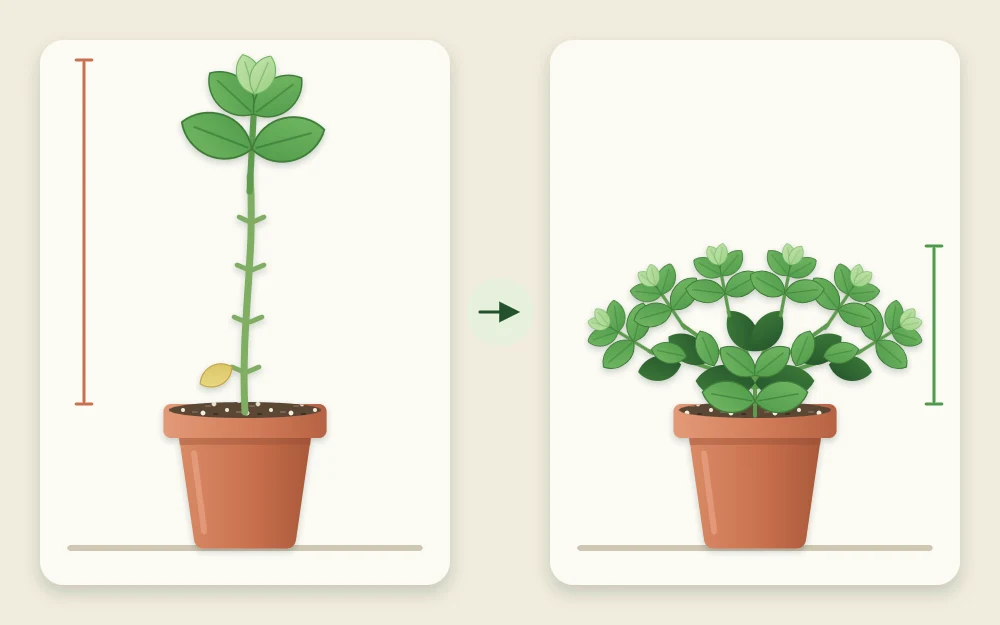
Left alone, a basil plant does one thing: it grows straight up. You end up with a single tall stem, a handful of leaves at the top and a long bare stretch below. It looks like a plant that needs more of something, when what it really needs is to be cut.
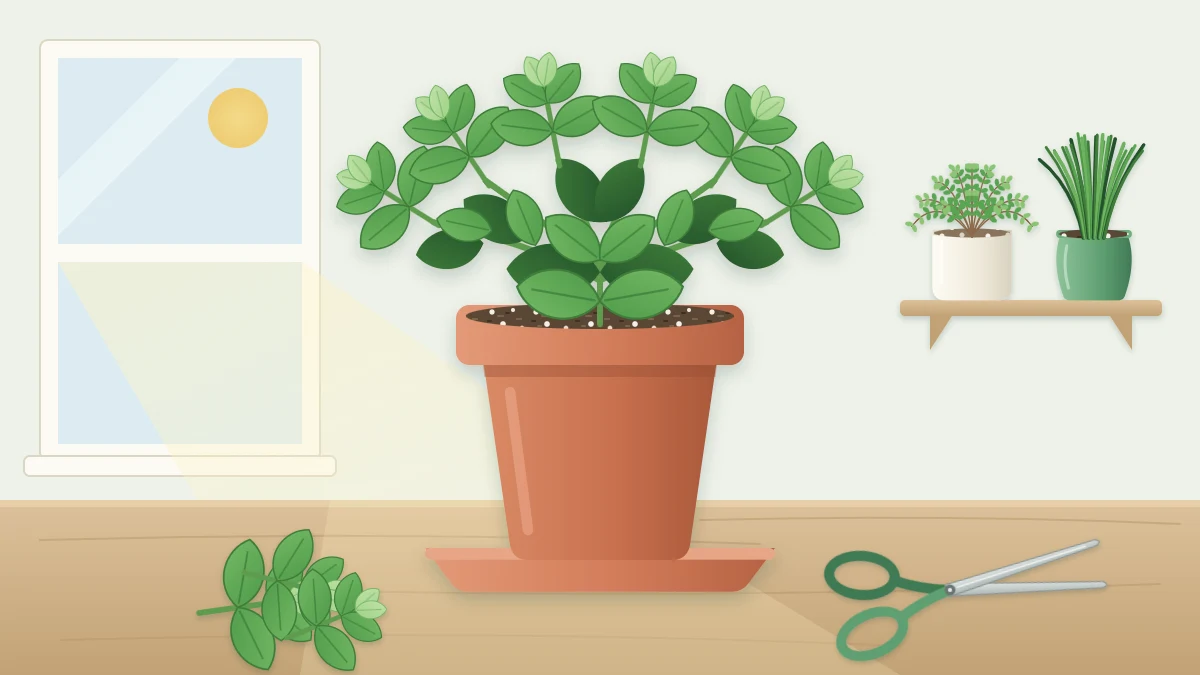
Once you know how to prune basil, that lanky stem becomes a short, wide plant with many branches and far more leaves to pick. The method is one small cut in the right place, repeated as the plant grows, and every piece you cut off goes straight to the kitchen.
Why cutting makes basil bushier
Basil grows from its tip. As long as that tip is in place, the plant puts most of its energy into getting taller, and the side shoots lower down stay small and dormant.
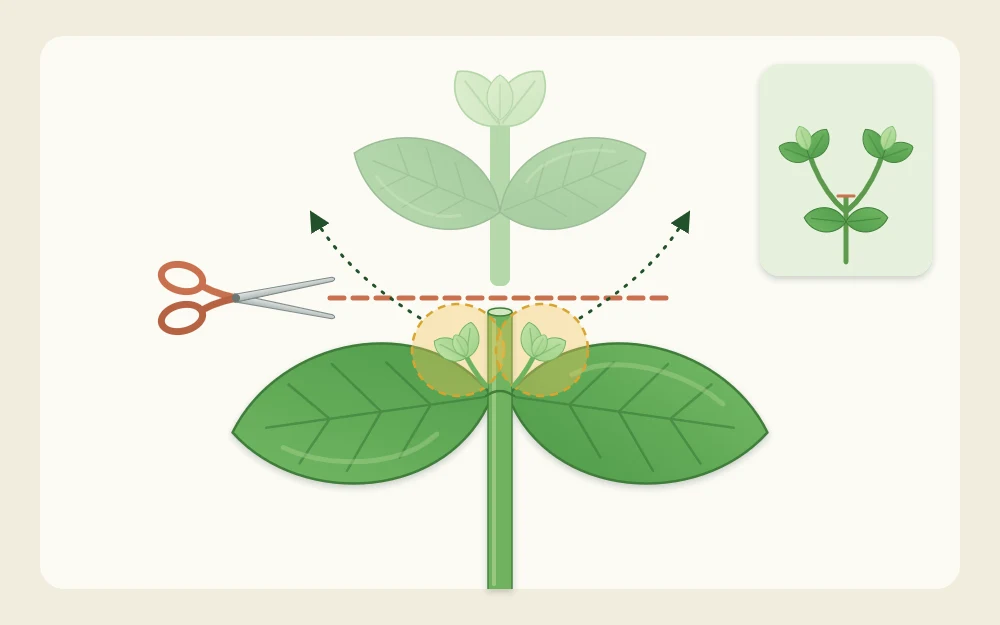
Look closely at the stem and you will see that the leaves sit in pairs, opposite each other. The point where a leaf pair joins the stem is called a node. In each leaf joint at that node there is a tiny shoot, often no bigger than a grain of rice: two per node, one on each side.
When you cut the tip off just above a node, those two small shoots wake up and grow out as new stems. One stem becomes two. Cut each of those later and two become four. That is the whole principle.
When to make the first cut
Wait until the plant has several sets of true leaves and stands roughly 6 in (15 cm) tall. The first pair of leaves a seedling opens are the smooth seed leaves, which do not count. A plant cut before it has enough leaf to feed itself can stall.
Do not wait much longer than that, though. The earlier a young basil starts branching, the lower and sturdier its framework will be.
How to prune basil, step by step
- Pick your tools. Use clean, sharp scissors or snips. Very soft tips can be pinched off with finger and thumbnail.
- Find a node with two tiny side shoots. Starting from the top of the stem, move down to a leaf pair where you can see small shoots in the joints. Make sure at least one or two leaf pairs will remain below your cut.
- Cut about a quarter inch (6 mm) above the node. Cut straight across the stem. Too close and you risk nicking the side shoots; too far above and you leave a stub that dies back.
- Let the plant respond. In good light and warmth, the two side shoots usually start to lengthen within a week or two.
- Repeat on each new branch. When a new branch has grown a few leaf pairs of its own, cut its tip above a node in the same way.
Keep going like this and the plant becomes a rounded dome of branches instead of a pole.
The mistake that makes basil bare
The most natural way to pick basil is also the least helpful: plucking the big lower leaves one at a time, because they are the largest and easiest to reach.
Those large leaves are doing much of the work of feeding the plant, and removing them does nothing to make the stem branch. The tip keeps growing upward, the bottom of the stem is stripped, and you are left with a bare stalk and a tuft on top.
Take your harvest from the top instead. Cutting tips gives you the youngest leaves and triggers branching at the same time.
Tip
If you need only two or three leaves for a garnish, take a small tip above a node anyway. A tiny cut in the right place still helps the plant’s shape.
Pinch out flower buds
Sooner or later basil tries to flower. Watch the stem tips for a tight cluster of small leaves stacked closely together, different from the usual open leaf pair. That is a flower bud forming.
Pinch it out as soon as you see it, cutting back to the leaf pair below. Once basil puts its energy into flowers and seed, leaf production slows and the leaves tend to become smaller and stronger tasting. Regular pruning delays this, because you keep removing the tips where buds form.
It will not put flowering off forever. Basil is an annual, and warmth, long days and age all push it toward bolting eventually; the guide to herbs bolting explains what is going on and what your options are.
How much to cut at once
As a rule of thumb, do not remove more than about a third of the plant in one session. Basil needs its remaining leaves to fuel the new shoots, and a plant cut back too hard, especially in weak indoor light, can take a long time to recover.
Little and often works better than a big cut now and then. Indoors in winter, growth slows down, so prune less and wait longer between cuts.
Good to know
Pruning cannot make up for poor light. A basil that is leggy because its window is too dim will grow leggy branches after you cut it. If stems are thin and pale with long gaps between leaf pairs, improve the light as well; the guide to growing basil indoors covers what the plant needs.
The cut tips are your harvest
Nothing you prune is wasted. Each tip is a sprig of the youngest leaves on the plant, ready for a salad, a sauce or a batch of pesto.
With basil, pruning and harvesting are really the same job. Other herbs are built differently and need cutting in different places; the guide on how to harvest herbs sets out the method for each type.
Pruning a tall, neglected basil
If your plant is already a single tall stem, you can still improve it. Follow the stem down from the top to a node that has healthy leaves and visible side shoots, and cut above it. Stay within the one-third guide, even if that means the plant is still taller than you would like.
When the new branches have grown a few leaf pairs, cut those back too. Avoid cutting into the bare base of an old stem, where there may be no live shoots left. If the plant is old and flowering hard, a new one is often the better choice.
Frequently asked questions
Where exactly do I cut basil?
Cut the stem about a quarter inch (6 mm) above a pair of leaves, choosing a pair that has two tiny side shoots in its joints. Those shoots then grow out as two new stems. Leave at least one or two leaf pairs on the stem below your cut so the plant can keep feeding itself.
How often should I prune basil?
There is no set interval, because growth depends on light, warmth and the size of the plant. Look it over every week or so and cut any branch tip that has grown a few new leaf pairs. In bright summer conditions that may be often; in a dim winter window it may be rarely.
Can I prune basil that has already flowered?
Yes. Cut the flowering tips back to a leaf pair with side shoots, staying within about a third of the plant at one time. This often brings a fresh flush of leaves, though an old basil that keeps trying to flower is near the end of its life, and a new plant may serve you better.